From Clinic to Corner Office: How the IEMBA Helped Stepping into Healthcare Leadership
For many medical specialists, professional life centres on urgency. Decisions carry human consequences, precision is vital, and long hours define the rhythm of work. What clinical practice rarely provides is structured preparation for organisational leadership. Yet modern healthcare increasingly requires it.
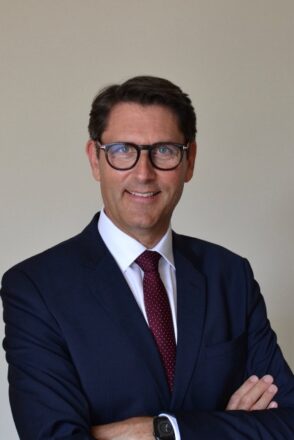
For Prof. Dr Tim von Oertzen, now CEO and Medical Director of a university hospital in Germany, this shift became clear after decades in clinical and academic medicine. Leading a complex institution demanded more than bedside expertise. It required the ability to manage systems, guide people, and make decisions with strategic depth. The International Executive MBA at the University of St.Gallen became the bridge between these worlds.
When Tim began the IEMBA, he was Chief Neurologist in Austria, already responsible for a department and its team. He sensed, however, that his ambitions were widening. Balancing clinical duties with postgraduate study could have been overwhelming, but he recalls it as energising.
“I really enjoyed learning new knowledge and experiencing how quickly the class community grew together,” he says. Strong support from his family ensured he could meet both commitments.
Midway through the programme he was appointed CEO and Medical Director of a university hospital. The timing aligned well. With most courses complete, he took two months between roles to write his thesis. Trying to sustain academic work during the transition, he says, would not have been realistic. This deliberate sequencing allowed him to start his new role fully focused.
Adapting to change with curiosity and discipline
Relocating and taking on a broader mandate introduced new layers of complexity, yet Tim was accustomed to adapting. He had previously worked in the UK and Austria and understood what international transition required. Returning to Germany added familiarity that eased the move.
His leadership approach in any new role begins with listening. “I am interested to learn what people did so far and how things work. I need this as a base assessment prior to implementing any changes.” For a university hospital, this understanding is essential.
He also paid attention to his own stamina. “I made sure that I got enough sleep in the first few months to keep my concentration sharp.” A small detail that reflects a disciplined leadership mindset.
The IEMBA as a pathway to broader impact
An Executive MBA may appear removed from clinical work, but for Tim it formed a natural progression: treating doctor, supervising doctor, healthcare manager. His motivation was clear. “Developing into management, having more impact, driving quality of healthcare.”
The programme’s integration of theory and practice proved immediately useful. He applied several frameworks in his new role, including in an unexpected area: marketing. “It was fragmented before. We started professionalising it and rebranding. Marketing is important to patients, but even more to employees.” In a sector where trust and culture shape performance, this work created tangible improvement.
Learning through a cohort of experienced peers
One of the defining features of the IEMBA is the diversity of the cohort. For Tim, the perspectives of leaders from start-ups, multinationals, and different cultural backgrounds had lasting influence. Healthcare sits at the intersection of public service, business, and academia, so insights from other industries broadened his strategic thinking.
“The perspective shifted not only by the programme content but also through interaction with my peers and our faculty,” he reflects.
Teaching and research remain central to Tim’s identity and continue to shape how he leads. Researchers must remain curious. Teachers must empower others. Both qualities underpin his approach to nurturing teams and driving innovation.
Leadership grounded in ethics and clarity
Asked how he balances strategy and responsibility in healthcare, Tim is unequivocal. “My strategic goals are providing the highest-quality healthcare, fulfilling our care provision obligation, and at third position, financial balancing.” Quality and responsibility come first; financial discipline follows.
Looking ahead, he highlights two qualities leaders will need most: the ability to empower others and the capacity to adapt. University hospitals face growing pressures and workforce shortages, yet expectations of quality continue to rise. Leaders must help teams stay aligned with the core purpose of healthcare.
A journey that expands the frame
Tim’s story is not one of stepping away from medicine. It is about expanding its impact. The IEMBA provided frameworks, community, and confidence, but most importantly, a wider lens through which to lead.
For clinicians moving into management or executives seeking a deeper understanding of healthcare, his experience offers a clear message. Leadership in this field demands curiosity, context, humanity, and the strength to navigate complexity with clarity.
Tim’s journey shows how medical expertise, combined with strategic education, can shape healthcare at system level.